- Two piezometers have been placed along the direction of low in a confined aquifer that is 30.0 m thick. The piezometers are 280 m apart. The difference in piezometric head bewteen the two is 1.4 m. The aquifer hydraulic conductivity is 50 m/d and the porosity is 20%. Estimate the travel time for water to flow between the two piezometers.
- An artesian aquifer 5 m thick with a piezometeric surface 65 m above the bottom confining layer is being pumped by a fully penetrating well. Thie aquifer is a mixture of sand and gravel, with a hydraulic conductivity of 6.1x10⁻⁴ m/s. A steady-state drawdown of 7 m is observed at a nonpumping well located 10 m away. If the pumping rate is 0.020 m3/s, how far away is a second nonpumping well that has an observed drawdown of 2 m?
- Drawdown at a 0.20 m diameter, fully penetrating well, which has been pumping at the rate of 1000 m3/day for a long enough time that steady-state conditions have been reached, is determined to be 0.75 m. The aquifer is unconfined and 12.0 m thick. An observation well 10 m away has been drawn down by 0.30 m.
- Suppose a spill of 5200 L of trichloroethylene (TCE) distributes itself evenly throughout an aquifer 10.0 m thick, forming a rectangular plume 2000 m long and 250 m wide (see figure below). The aquifer has porosity of 0.40, hydraulic gradient of 0.001, and hydraulic conductivity of 0.001 m/s.
- If the transmissivity of an aquifer is 2.51x10⁻³ m2/s and the storativity is 2.86x10⁻⁴, calculate the drawdown that will result at the end of two days of pumping a 0.5 m diameter well at a rate of 0.0194 m3/s.
a.) Determine the hydraulic conductivity of the aquifer.
b.) What is the drawdown at an observation well 25 m away?
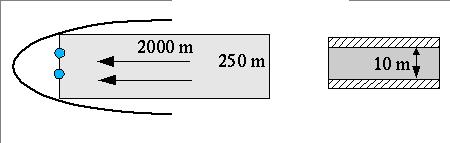
a.) What would be the concentration of TCE (in mg/L) in this idealized groundwater plume? Could this much TCE be totally dissolved in the aquifer at equlibrium, given the solubility of TCE?
b.) Using capture zone curves, design an extraction field to pump out the plume under the assumption that the wells are lined up along the leading edge of the plume, with each well to be pumped at the same rate, not to exceed 0.003 m3/s per well. What is the smallest number of wells that could be used to capture the entire plume? What minimum pumping rate would be required for each well?
c.) What would the optimal spacing be between the wells, at the minumum pumping rate?
d.) What are the assumptions made in designing this well field?