 >>>>
>>>>
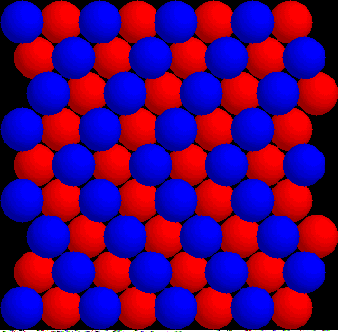
Validity of continuum theory
In the continuum theory, one can take a piece of steel and assign some property. For example we can say that the steel has an Young's modulus of E= 30 E6 psi. That property is valid for a volume element of the size of the test piece. The question is that if we keep subdividing the volume element till it becomes very small will that property still retain its meaning. It may still hold good if the volume element is 1 mm3. How about if the element is of the order of a few nanometers, i.e., in the scale of atomic distance. Obviously the idea is the material is continuous breaks down at that scale.
In a general sense, the concept of continuum depends on the problem. For example a discontinuity on the same order of the problem being modeled will not yield the right result. For example a material discontinuity (rarefied atmosphere) of a few centimeters in the outer space can be ignored when modeling the flight of a rocket of characteristic dimension of a few meters; whereas a cavity the size of a few micrometers cannot be ignored when attempting to solve wave propagation problem where the characteristic dimensions are also in the same order. As a general rule, if the discontinuity is not more than two orders of magnitude that of the characteristic dimension in the problem then the concept of continuum mechanics can be safely applied.
>>>>