

EML 5709 Homework 4 Spring 1996
 of a circular cylinder is expanding in time.
The cylinder is surrounded by an incompressible fluid extending to infinity
in all directions.
Write the partial differential equation and boundary
conditions for the velocity potential
in the incompressible fluid in terms of and its derivatives.
of a circular cylinder is expanding in time.
The cylinder is surrounded by an incompressible fluid extending to infinity
in all directions.
Write the partial differential equation and boundary
conditions for the velocity potential
in the incompressible fluid in terms of and its derivatives. located at
  , and one of opposite strength at
 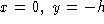 .
In particular, find
.
In particular, find  and
and  and sketch the streamlines.
In what direction is the velocity on the x-axis (y=0)?
What can you say about the flow corresponding to a single vortex
located a distance h above a solid wall?
Mirroring an image of the features of a flow
into a solid region is called
the mirror method.
Give the pressure on the wall.
Explain why the effects of wingtip vortices are much less pronounced
when the plane is flying close to the ground.
located at , and one of opposite strength at .
In particular, find F and from it and sketch the streamlines.
Show that F is real on the x-axis.
Find the complex conjugate velocity and show that it is horizontal on the
x-axis.
Find the pressure on the wall from W.
and sketch the streamlines.
In what direction is the velocity on the x-axis (y=0)?
What can you say about the flow corresponding to a single vortex
located a distance h above a solid wall?
Mirroring an image of the features of a flow
into a solid region is called
the mirror method.
Give the pressure on the wall.
Explain why the effects of wingtip vortices are much less pronounced
when the plane is flying close to the ground.
located at , and one of opposite strength at .
In particular, find F and from it and sketch the streamlines.
Show that F is real on the x-axis.
Find the complex conjugate velocity and show that it is horizontal on the
x-axis.
Find the pressure on the wall from W. at the origin,
and a strong source of strength
at the origin,
and a strong source of strength
 at
at 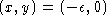 .
Show that for small
.
Show that for small  , we get potential flow past a circular
cylinder.
Draw the streamlines.
Where does the fluid coming out of the source at
the (-epsilon,0) end up?
, we get potential flow past a circular
cylinder.
Draw the streamlines.
Where does the fluid coming out of the source at
the (-epsilon,0) end up? at the origin.
Draw the streamlines.
What is the velocity at large distances?
Where does the fluid coming out of the source at
the origin end up?
at the origin.
Draw the streamlines.
What is the velocity at large distances?
Where does the fluid coming out of the source at
the origin end up? -plane is given by

where  .
Show that F is real on the unit circle, so that it is a streamline.
Find
.
Show that F is real on the unit circle, so that it is a streamline.
Find  on the unit circle
  in terms of the angular coordinate
  .
Show that stagnation points occur at
.
Show that stagnation points occur at  and
and  .
Identify F at large distances.
Now draw the streamlines and describe the flow.
.
Identify F at large distances.
Now draw the streamlines and describe the flow.
-plane of the previous question, assume that the corresponding
physical (x,y)-plane is found from

Identify the critical points where 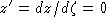 .
Locate these also in the z-plane.
Now sketch and describe the curve in the z-plane corresponding to
the unit circle in the -plane.
Show that for small , this curve is approximately equal to
.
Locate these also in the z-plane.
Now sketch and describe the curve in the z-plane corresponding to
the unit circle in the -plane.
Show that for small , this curve is approximately equal to
 . Describe this approximate curve.
Draw the streamlines in the z-plane.
. Describe this approximate curve.
Draw the streamlines in the z-plane.
 . .
Approximate this for small values of .
Rewrite this in terms of
. .
Approximate this for small values of .
Rewrite this in terms of  to get

 . Comment on the result.