An intercooler is a form of a heat exchanger. It is similar to a car radiator. Heat transfer takes place between two fluids that do not come in contact with each other directly. The compressed air from the turbo charger enters tubes in the intercooler and a cross flow of ambient air is used to cool the compressed air. After the air is cooled it then enters the intake manifold. The intercooler is usually mounted in front of the radiator, at the pressure outlet of the turbo charger.
When the air is compressed using a turbo charger it also sees a rise in temperature. This rise in temperature causes an increase in volume. An intercooler is used to cool the air so the volume is decreased and more air can be packed in. If the intake air has a temperature that is to high detonation or knocking can occur. This is because the air intake temperature can be great enough to ignite the fuel causing knocking.
The benefits of an intercooler can be shown by looking at the overall heat transfer that occurs. The equation for the overall heat transfer is
Q=U*A*(T1-T2)*(F/ln(T1/T2))
where Q is the amount of energy that is transferred, U is the heat transfer coefficient, A is the surface area of the tubes in the intercooler, F is a correction factor. The amount of heat loss or gained on one side of the heat exchanger is found by
Q=mCpDT
where Q is the amount of energy that is transferred, m is the mass flow rate of the air Cp is the heat capacity of the air, and DT is the temperature difference.
Intercoolers are not always practical for all applications. One way to test to see if the intercooler is practical it with the effectiveness of the intercooler using the following equation
Eff=(T1-Ti)/(T1-Tw)
An intercooler is more effective at low flow rates such as idle. For example the steady state temperature for idle is around 100 degrees F and at full throttle it is around 175 degrees F. This is one reason why intercoolers are not used on al applications.
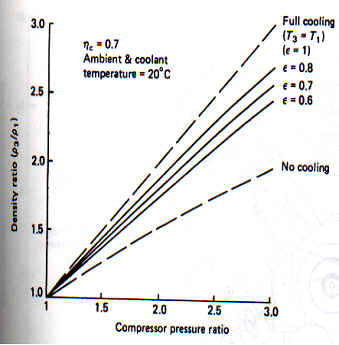
When an intercooler is used a pressure drop is experienced due to the losses in the pipes of the intercooler. A graph of the density ratio, which is the effects of intercooling, vs compressure pressure ratio can be seen in figure 1.
Figure 1. Compressor pressure ratio vs Density ratio.
Effect on charge cooling on the density ratio is seen on the graph for a typical isentropic compressor efficiency of 70% and an ambient temperature of 20 deg C. The heat transfer is proportional to pressure drop. This shows that the m
Effects of Inter cooling on Performance