QFS-based Quantum devices
The development of scalable quantum hardware requires qubit platforms that combine long coherence times, strong controllability, and compatibility with on-chip integration. Conventional solid-state qubits benefit from mature nanofabrication and fast control, but their performance is often limited by materials disorder and surface defects. In contrast, atomic and trapped-particle systems exhibit excellent coherence due to isolation in vacuum, yet face substantial challenges in scalability and device complexity. Harnessing the complementary strengths of these approaches provides a promising pathway toward scalable and robust quantum devices.
One focus of our QISE research explores a hybrid approach based on single electrons bound to the surfaces of quantum fluids and solids (QFS), particularly superfluid helium (He II) and solid neon. In these systems, electrons reside in vacuum above atomically simple substrates, where Pauli repulsion prevents penetration into the medium while polarization attraction provides vertical confinement (see Fig.1). This environment strongly suppresses charge noise while retaining large electric-dipole coupling to external fields, enabling direct integration with superconducting microwave circuits and circuit-QED architectures. Electrons on superfluid He II provided an early demonstration of the exceptional cleanliness of quantum-fluid surfaces and enabled controlled transport and confinement of surface electrons. However, the deformable liquid interface supports surface excitations and vibrations that broaden electron spectra, motivating the exploration of solid quantum-fluid surfaces as more stable hosts for coherent qubit operation.
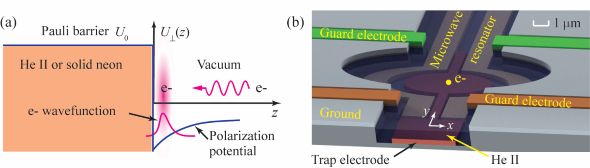
Figure 1: (a) Schematic showing the Pauli barrier and surface-bound state of an electron on He II or solid neon. (b) Schematic of a typical He II–filled microchannel device for trapping and controlling a surface electron.
This motivation led to the development of electron-on-solid-neon (eNe) qubits, in which a thin film of ultrapure solid neon replaces the liquid helium surface. The rigid solid-neon surface suppresses surface excitations present in liquid helium, leading to substantially improved coherence, while GHz-scale transition energies arise from lateral confinement of surface electrons by nanoscale curvature features that enable strong coupling to superconducting microwave resonators. Recent experiments have demonstrated narrow transition linewidths, coherence times approaching the millisecond scale, and single-qubit gate fidelities exceeding 99.97%, establishing the eNe system as a promising charge-based qubit platform compatible with circuit-QED technology.
Nonetheless, in conventional planar eNe devices, electrons can bind stochastically to nanoscale surface curvature features that arise during neon film growth (see Fig. 2), leading to device-to-device variability and limiting scalability. To address this issue, we are developing an architecture based on magnetically levitated quantum-fluid and quantum-solid microparticles as deterministic carriers for surface-electron qubits. In this approach, micron-scale solid-neon particles are levitated above a superconducting chip using patterned on-chip current loops, eliminating direct contact with disordered substrates. Each levitated particle provides an atomically clean, curvature-defined surface for trapping a single electron, enabling reproducible qubit spectra and strong, tunable coupling to on-chip microwave resonators. This architecture preserves the intrinsic advantages of the eNe platform—vacuum isolation, strong electric-dipole coupling, and lithographic compatibility—while naturally supporting scalable multi-qubit arrays.
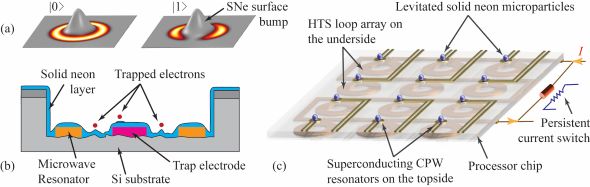
Figure 2: (a) Schematic wavefunction profiles of an electron self-bound to a SNe surface bump in the ground state and first excited state. (b) Cross-sectional schematic of the device in Fig. 1(b), showing electrons bound to surface bumps on the SNe film deposited on the device. (c) Conceptual diagram of the on-chip architecture using arrays of magnetically levitated SNe microparticles as electron qubit carriers.
The levitated-particle approach also enables additional quantum-information functionalities beyond charge-qubit operation. In particular, the spin degree of freedom of an electron bound to a levitated solid-neon particle provides a natural platform for long-lived quantum memory, while retaining electrical tunability and circuit-QED-based control and readout. In parallel, the same levitation concepts can be extended to levitated He II droplets doped with Er3+ ions, where long-lived electronic spin states combined with optical transitions enable quantum-network nodes that interface microwave, mechanical, and optical degrees of freedom.
Besides these efforts, our group is also pursuing two distinct quantum-sensor thrusts based on He II. In one direction, levitated He II droplets supporting high-Q whispering-gallery modes are developed as quantum vibration sensors, where minute mechanical perturbations are transduced into shifts of optical or microwave resonances with quantum-limited sensitivity. In another direction, we study He II Josephson devices, in which phase-coherent superfluid weak links form the basis of quantum rotation sensors analogous to superconducting SQUIDs, but operating with neutral superfluid flow. These efforts exploit the macroscopic quantum coherence and ultralow dissipation of superfluid helium and are focused specifically on precision sensing and fundamental measurements, independent of qubit and quantum-network development.