With a project like this with such a physics-heavy background there is a lot of theoretical background that needs to be mastered prior to creating simulations or proof-of-concept device.
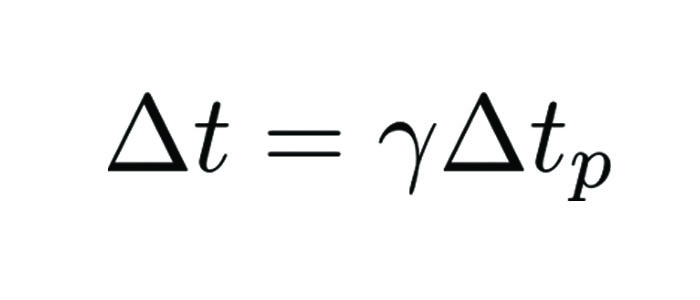
Special relativity is easy to understand. The faster a body goes, the higher gamma value it has. As we can see on the equation on the right time percieved and time measured from a different reference planes (ex. Earth and a Spaceship). Basically if a body attains high speeds (Spaceship) time will seem longer from the point of view on the non moving reference plane (Earth).
General Relativty is similar to Special Relativiy but instead of speed being the factor that dialates time, it is acceleration, more specifically gravity. The equation shown on the left is what Einstein's theory of relativity is based on. This equation might be deceivingly simple, but in reality is a 16-tensor equation. It would be nearly impossible for us to work with something of that magnitude. Thankfully Karl Schwarzschild took many assumptions and gave us something that we are able to work with.
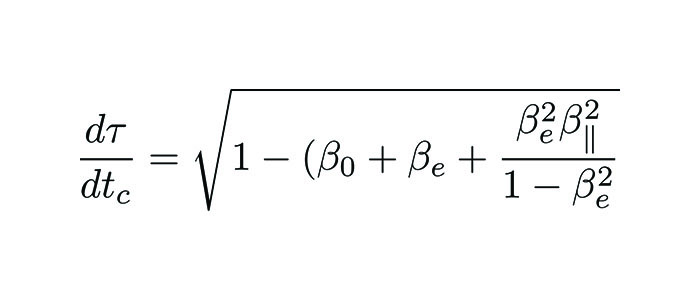
This metric simplifies a lot of what Einstein's Equation brought. By taking ~16 assumptions we are able to simplify Eisntein's Equation of General Relativity into what is shown to the right, it is called the Schwarzschild Metric. This metric allows us to imput information about velocity and acceleration to get a gamma value to be used as simply as it is done on special relativity calculations. The different betas match different movements that the body (Spaceship) is experiencing against a grevity well (Planet). These include perpendicular speed, orbital speed and tangential speed.