Background
Photovoltaic (PV) cells produce power when photons in light knock electrons in a semiconducting material from their valence band into the higher-energy conducting band, where they can travel through an electric circuit and produce a usable current. This phenomenon is governed by the equation:
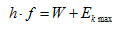
where h is Plank’s constant, f is the frequency of oscillation of the photon, W is the work required to move the electron from its valence band into the conducting band, and Ekmax is the resulting kinetic energy of the electron [3]. In a PV cell, silicon is often used as the semiconducting material because photons with a frequency in the visible light range will have enough energy to overcome W. A PV array performs best when oriented perpendicular to the sun because that is when the cell’s effective surface area facing the incoming photons will be maximum.
The sun maintains a nearly constant azimuth angle relative to the earth’s axis of rotation as it rotates 360o in one day. The sun is visible to a stationary observer for a maximum of about half of this rotation, so the main tracking axis needs to have a range of motion close to 180o. Using one axis would be sufficient to track the sun throughout a single day because of the nearly constant solar altitude. However, the azimuth angle varies by 47o between the summer and winter solstices, as shown in Figure 1. In order to maintain perpendicularity all year long, a second axis of rotation needs to be incorporated into the tracking system to account for the changes in azimuth angle.
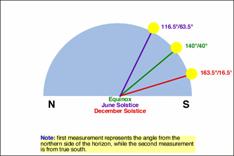 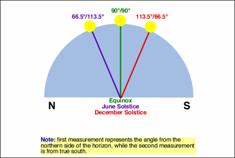
![Text Box: (a) (b) Figure 1 – Variations in solar altitude at solar noon for (a) 50 degrees N and (b) at the equator during the June solstice, equinox, and December solstice [4]](background_clip_image007.gif)
|
|