Research area

Land–Atmosphere Interaction

Characterizing the dynamics of flow, particles, heat, and scalar transport in complex environments at the interface of the lower atmosphere and Earth’s surface.


Atmospheric Stability and Smoke-Plume Dynamics

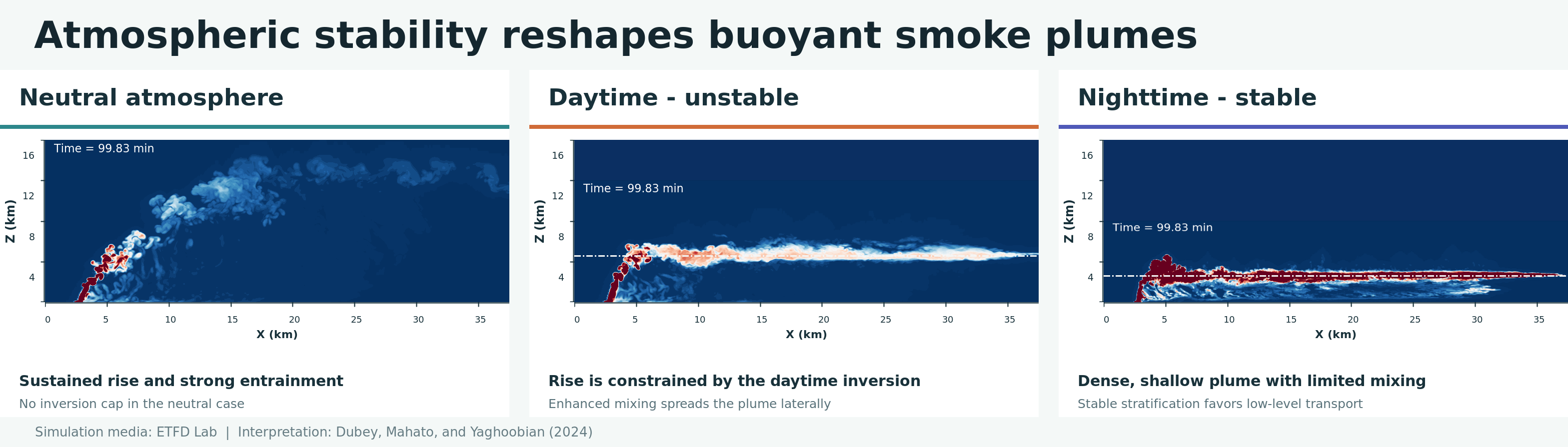
Atmospheric stability changes the vertical structure of smoke plumes and the rate at which they entrain and mix with surrounding air. Daytime unstable conditions promote vigorous vertical and lateral dispersion, while nighttime stable conditions constrain plume rise and can maintain higher smoke concentrations closer to the surface. Neutral conditions provide an intermediate reference for assessing these competing effects.

Read the Physics of Fluids paper: “Effect of the Atmospheric Stability Condition on Smoke-Plume Dynamics”

Smoke-plume evolution compared under daytime unstable, neutral, and nighttime stable atmospheric conditions, with inversion heights marked by thin white lines
Atmospheric stability regulates plume rise, mixing, and downwind smoke dispersion.

Fuel-Moisture Effects on Smoke-Plume Dynamics

Fuel moisture content modifies fire heat release and therefore the buoyant forcing that drives plume development. Increasing moisture changes plume rise, shape, concentration, propagation, and interaction with the surrounding flow; the lowest-moisture case produces the strongest heat flux, while the highest-moisture case produces the weakest.

Smoke-plume simulations compared for fuel moisture contents of 0, 10, 50, and 80 percent
Plume dynamics across four fuel-moisture conditions, using a consistent comparison layout.

Effects of Urban Boundary-Layer Turbulence on Firebrand Transport

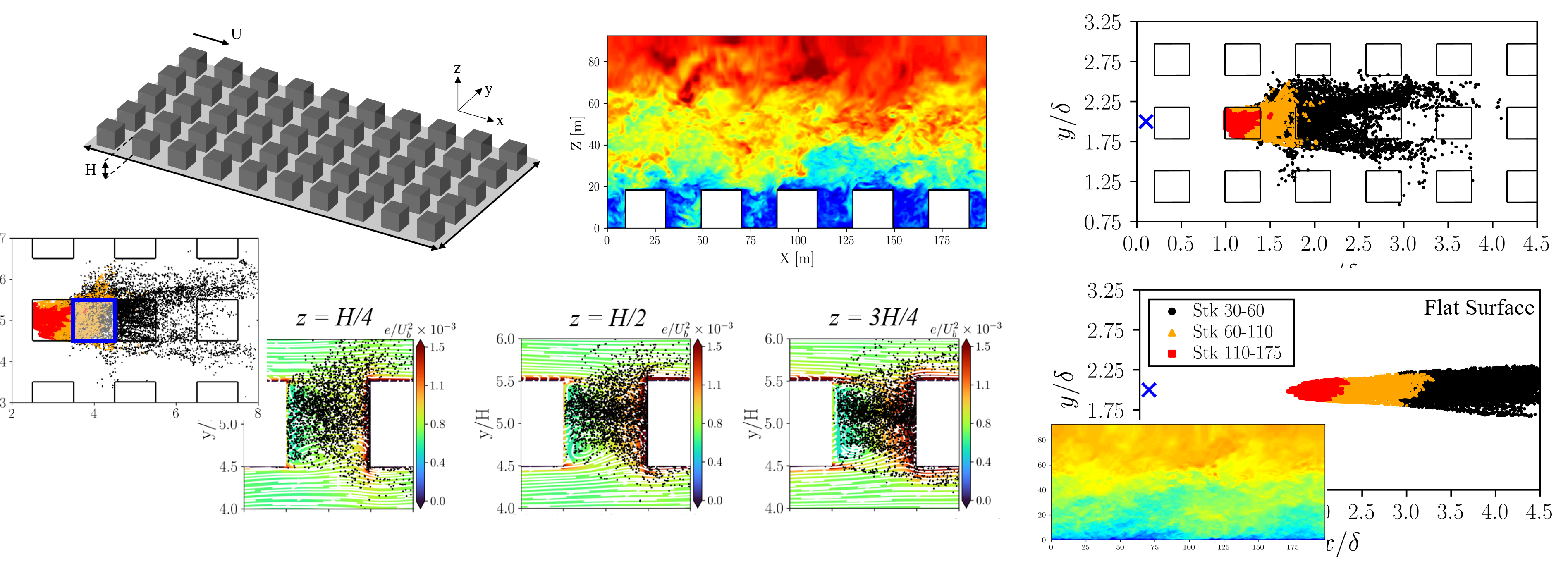
Large-eddy simulations determine how urban form and terrain reshape turbulent transport, airborne trajectories, and the landing distributions of firebrands. Resolving the heterogeneous flow around buildings reveals preferential pathways and accumulation zones that are not captured by spatially uniform wind assumptions.

Read the Fire Safety Journal paper: “Effects of Urban Boundary Layer Turbulence on Firebrand Transport”

Firebrand trajectories and deposition patterns over idealized urban topography
Urban turbulence modifies firebrand pathways and the spatial distribution of landing locations.

Effect of Topography on Firebrand Landing and Settling

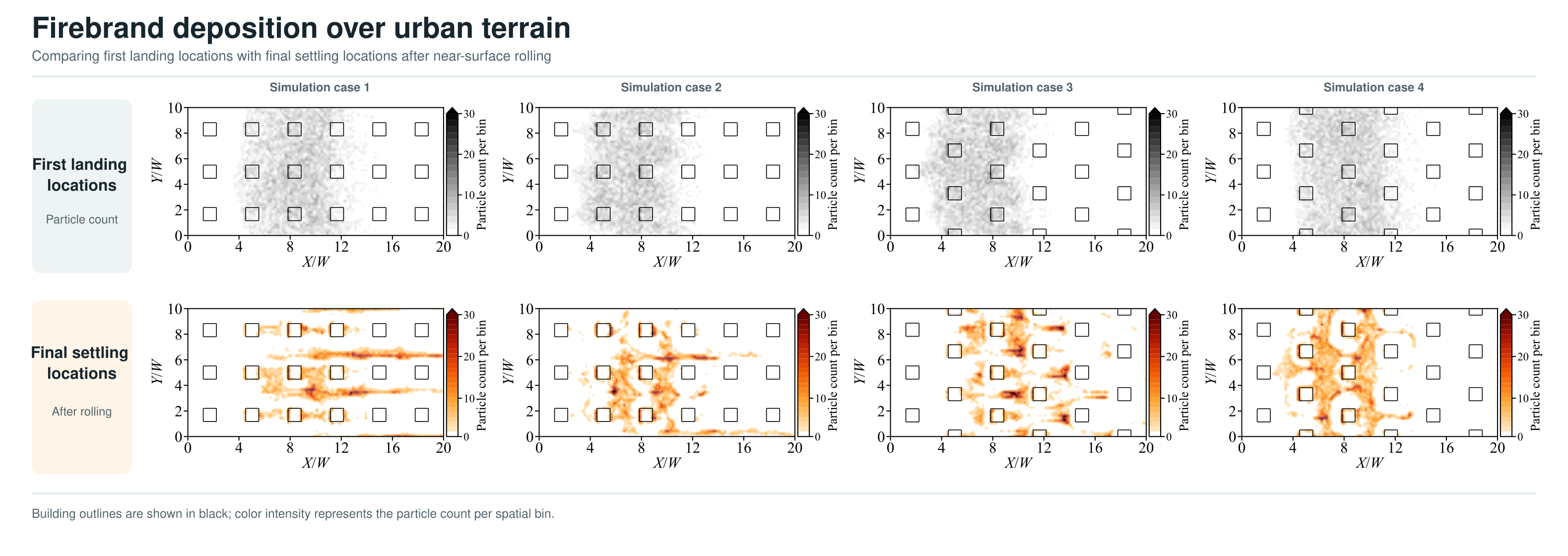
Large-eddy simulations track 50,000 firebrands with diameters from 2 to 5 mm after release over idealized urban regions. The resolved near-surface flow and terrain configuration alter where firebrands first contact the ground and where they finally settle after rolling, revealing deposition pathways that cannot be inferred from airborne trajectories alone.

Four urban-terrain simulation cases comparing firebrand first landing locations with final settling locations after rolling
Particle-count maps distinguish first landing from final settling after near-surface motion across four simulation cases.

Plume Dynamics in Wildland–Urban Interfaces

This work examines how buoyancy, atmospheric structure, and built-environment geometry control plume rise, entrainment, intermittency, and downstream smoke transport.

Animated numerical simulation of a buoyant plume evolving through a wildland–urban interface
Time-resolved plume evolution in a turbulent atmospheric flow.

Flight Behavior of a Smoldering Particle

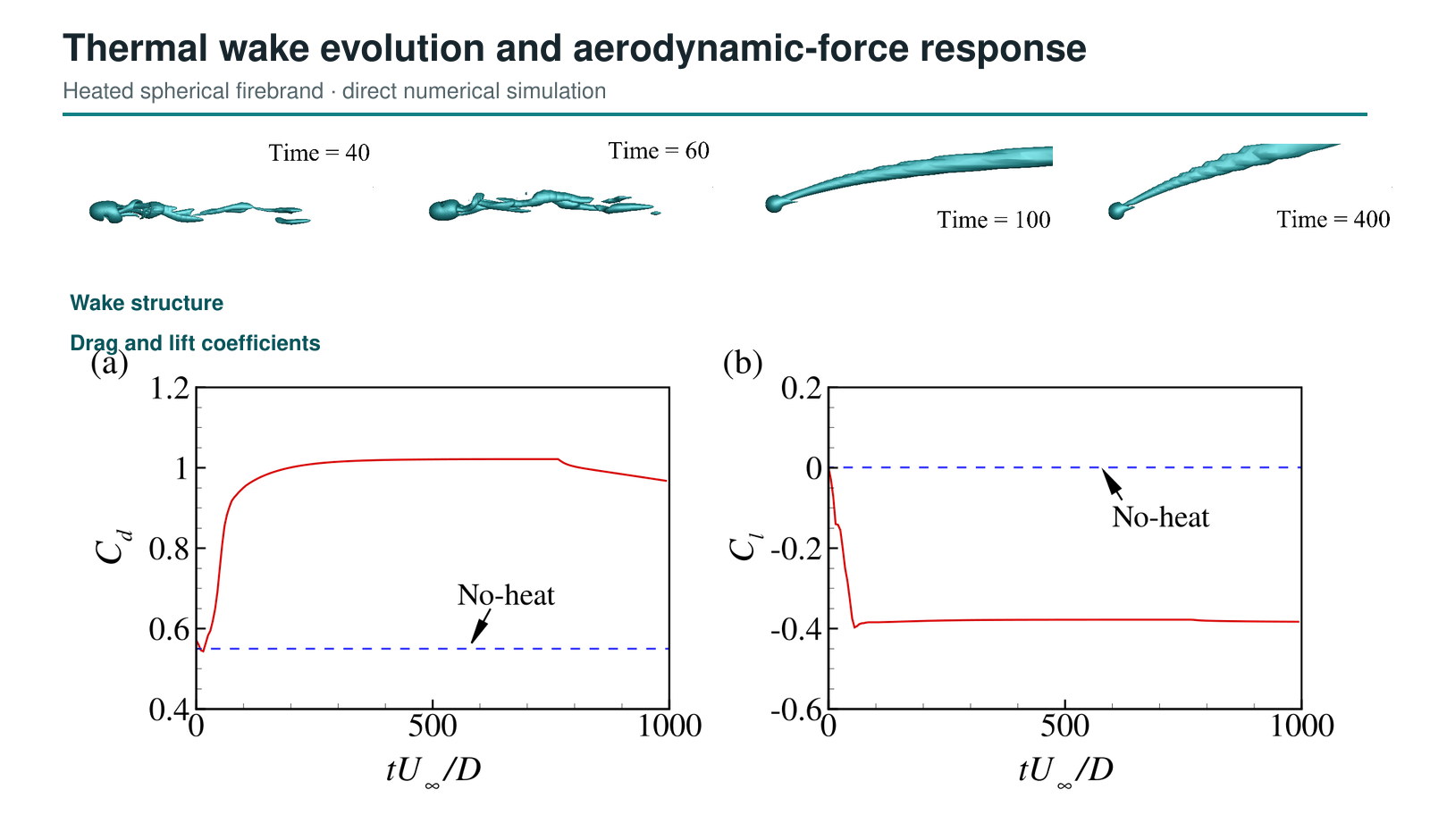
Direct numerical simulations show how heating modifies the wake and aerodynamic forces acting on an idealized spherical firebrand. Buoyancy reorganizes the wake into elongated thermal plumes, raises the drag coefficient, and produces a sustained negative lift coefficient; incorporating these transient force changes improves predictions of flight trajectory and landing location.

Read the Theoretical and Computational Fluid Dynamics paper: “Aerodynamic Force Modifications of a Spherical Particle with Varying Temperature”

Heated spherical firebrand wake evolution together with time histories of drag and lift coefficients
Heating transforms the particle wake and produces substantial departures from the non-heated drag and lift coefficients.

Spatiotemporally Variable Fuel Moisture and Fire Behavior

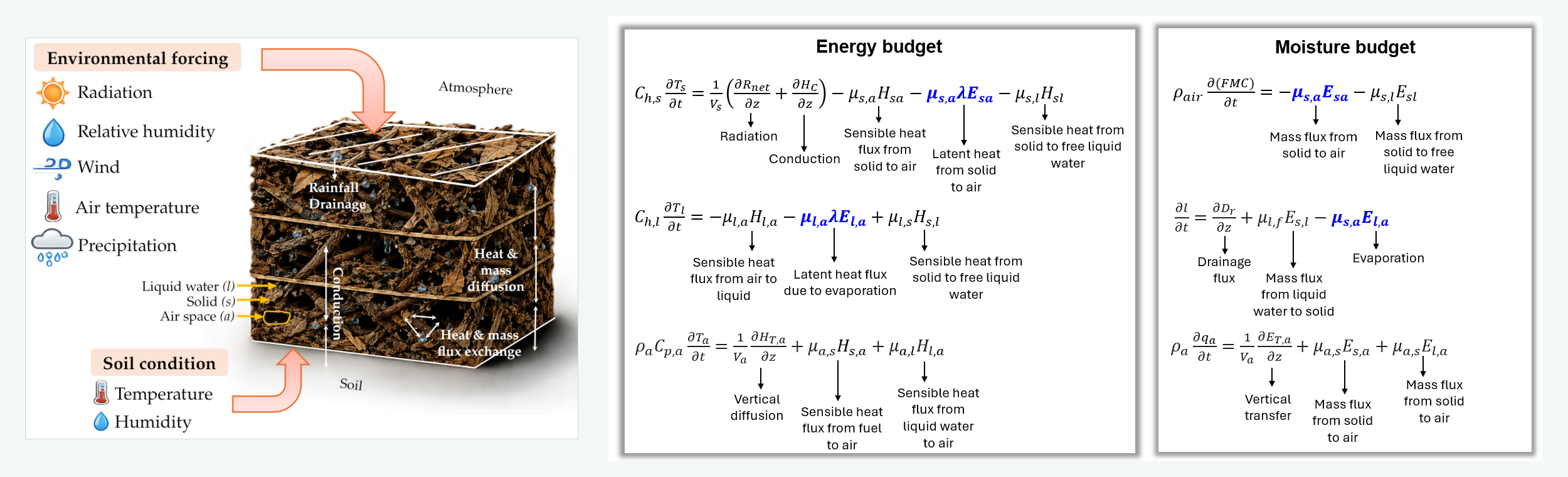
A physics-based thermodynamic model predicts local dead-fuel moisture and exchanges heat and moisture with the fire-dynamics solver in both directions. The coupled approach captures spatial and temporal variation in drying, ignition, fire spread, heat-release rate, and plume forcing more realistically than a uniform or prescribed fuel-moisture assumption.

Read the Environmental Modelling & Software paper: “A Physics-Based Model of Thermodynamically Varying Fuel Moisture Content for Fire Behavior Prediction”

Subgrid-Scale Modeling of Settling Particles in Turbulent Boundary Layers

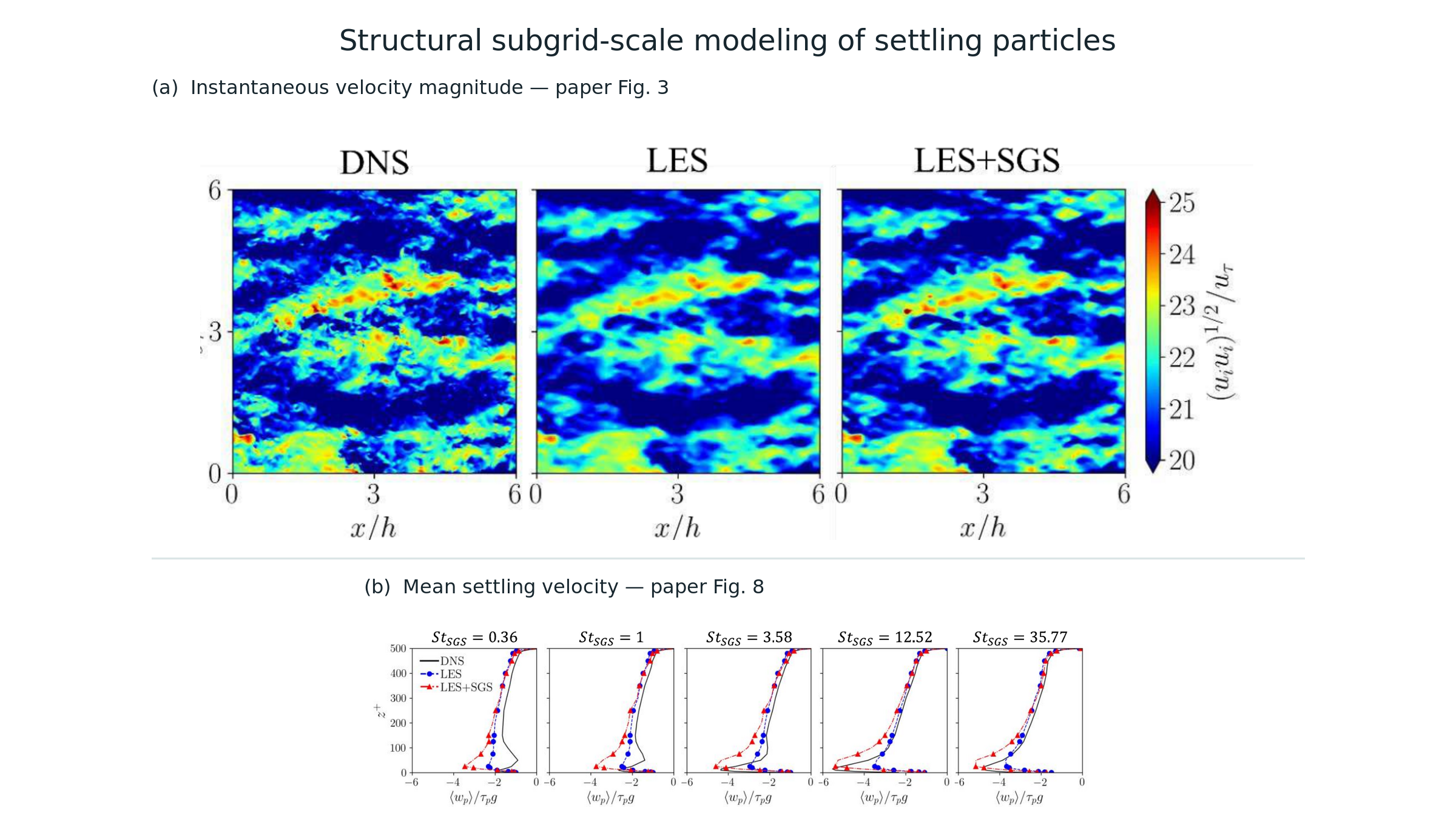
Large-eddy simulations are used to study how unresolved turbulence influences inertial particles settling through an anisotropic boundary layer. A structural subgrid-scale model partially restores kinetic energy lost through spatial filtering and improves predictions of particle acceleration, velocity fluctuations, settling, dispersion, clustering, and deposition, with the strongest effects occurring for lower-inertia particles.

Read the Physics of Fluids paper: “Application of a Structural Subgrid-Scale Model to Large-Eddy Simulations of Settling Particles in the Turbulent Boundary Layer”

Paper figures comparing instantaneous velocity magnitude and particle settling velocity for DNS, LES, and LES enhanced with a structural subgrid-scale model
Paper Figures 3 and 8 compare resolved turbulence and settling behavior across DNS, LES, and LES with the structural SGS model.

Flow and Scalar Transport in Complex Terrain



Coupled surface-energy-balance and large-eddy simulations reveal how nonuniform diurnal heating, roof materials, and terrain geometry produce local stable and unstable layers. These thermal gradients modify pressure, turbulence, ventilation routes, and the removal of heat and passive scalars across morning, afternoon, and evening conditions.

Read the 2022 Boundary-Layer Meteorology paper · Read the 2014 Boundary-Layer Meteorology paper

Animated flow and scalar concentration fields over complex terrain
Time-resolved scalar transport through terrain-generated and thermally modified turbulence.

Bio-Thermo-Fluid Dynamics

The lab studies how flow, heat transfer, environmental forcing, and geometry interact to shape the function of natural and bio-inspired systems.

Animated thermo-fluid simulation of a natural bio-inspired structure
Coupled flow and thermal transport in a natural structure.

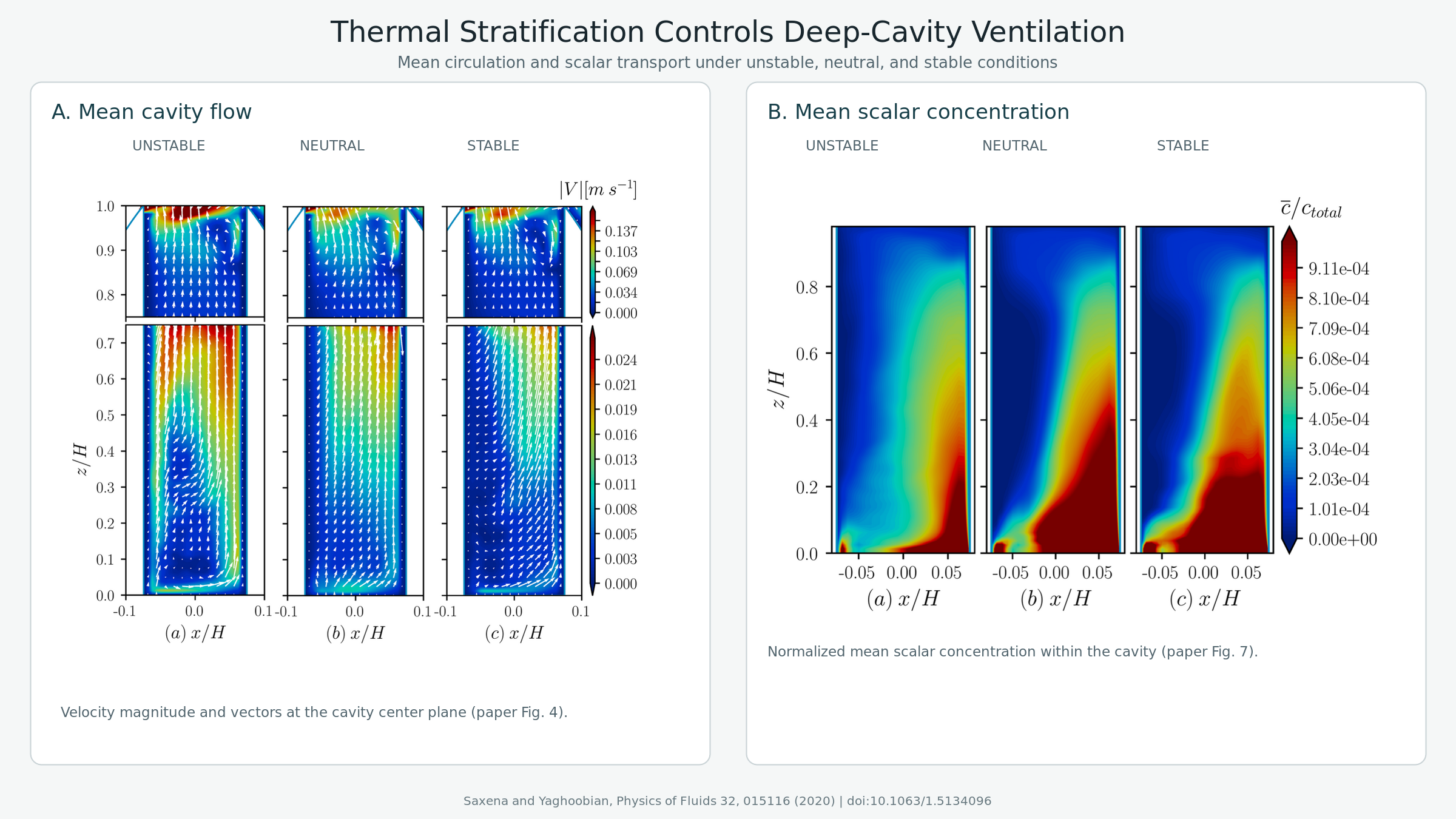
Stratification Effects on Flow and Scalar Transport Through a Deep Cavity

Large-eddy simulations of a bioinspired deep cavity isolate how daytime and nighttime stratification alter internal circulation and scalar exchange. Ventilation depends jointly on the entrance vortex and stability within the lower cavity: unstable conditions strengthen suction and buoyant transport, while stable conditions suppress vertical exchange.

Read the Physics of Fluids paper: “Stratification Effects on Flow and Scalar Transport Through a Deep Cavity”

Combined paper figures showing cavity flow structures and scalar transport under different stratification conditions
Paper Figures 4 and 7 show how stratification modifies cavity circulation and the resulting scalar exchange.

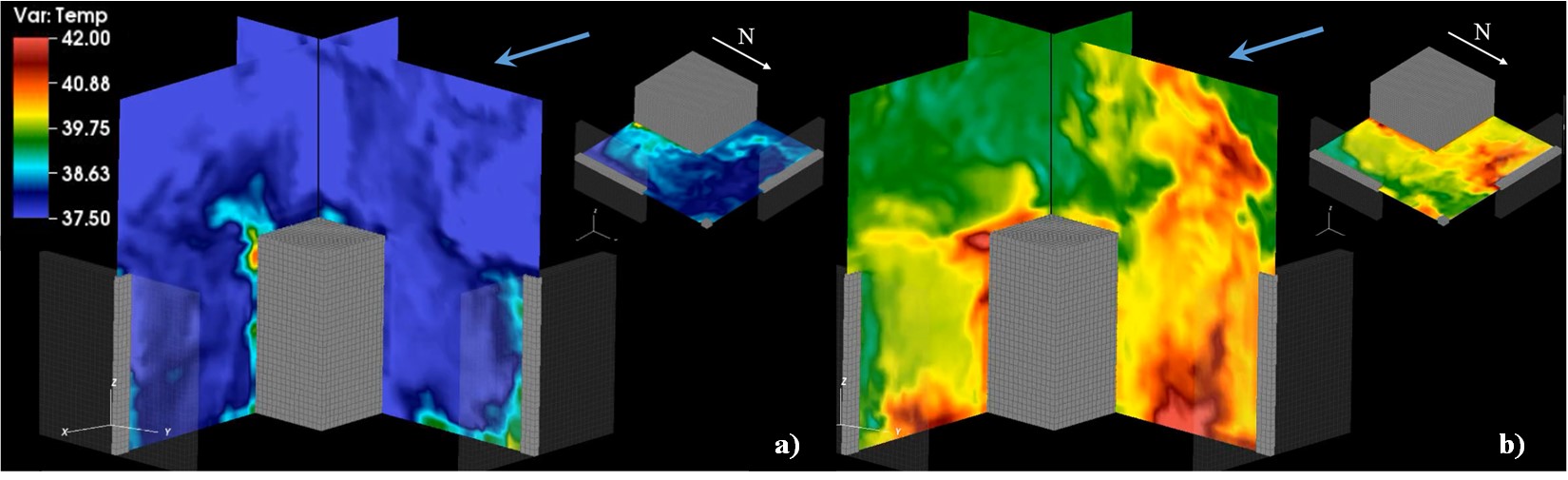
Diurnally Variable Urban Microclimates

Coupling a three-dimensional urban surface-energy model with large-eddy simulation resolves realistic, spatially nonuniform surface temperatures. As solar exposure and shadowing evolve, the resulting buoyancy and pressure gradients reorganize street-canyon turbulence, near-surface ventilation, and heat transport.

Read the Boundary-Layer Meteorology paper: “An Improved Three-Dimensional Simulation of the Diurnally Varying Street-Canyon Flow”

Instantaneous simulated temperature field in a diurnally heated urban environment
Instantaneous temperature field produced by spatially varying urban heating.

Flow and Transport over Complex Plant Canopies


Large-eddy simulation of atmospheric flow is combined with local canopy geometry and trajectory modeling to predict transport through complex vegetation. In the golf-shot application, tree-induced turbulence and wind-direction changes produce substantial sensitivity in the ball’s flight path and landing position.

Read the Sports Engineering paper: “A Computational Approach for Predicting Plant Canopy Induced Wind Effects on the Trajectory of Golf Shots”

Animated vorticity field showing turbulent flow through a complex plant canopy
Canopy-generated turbulence and its influence on a wind-sensitive trajectory.